


About
Language
Credits
Sound is difficult to describe. It is complex, subjective, and ambiguous, which makes defining a clear audio direction for a game challenging.
This tool condenses that direction into a concise document to align the audio team and creative leadership around a shared vision.
This tool is meant to support the process, not replace it. It is by no means a one-size-fits-all solution, and there will inevitably be edge cases and nuances that require individual consideration.
That said, it provides a strong starting point to better understand, articulate, and communicate the intended audio direction.
Make a copy of the template Google Slides Presentation and save it locally.
The goal of this framework is not to be 100% accurate. You can see it more as a conversation starter, a live document that gets refined thru the diffetent production stages. Of course things will need to be refined along the way, and that is actually the point: it keeps everyone listening in the same direction.
And importantly, it has to be stupid simple. The last thing we want is to write yet another AI-generated 40-page document that nobody will read anyway. So here’s our quick and dirty Google Slides presentation template of 4 slides. It is so ugly that you know people will read it, and that no AI can do that ugly. Each slide takes the team from a broad definition of the sound to a more and more precise one, until we land on actual, actionable sound design direction.
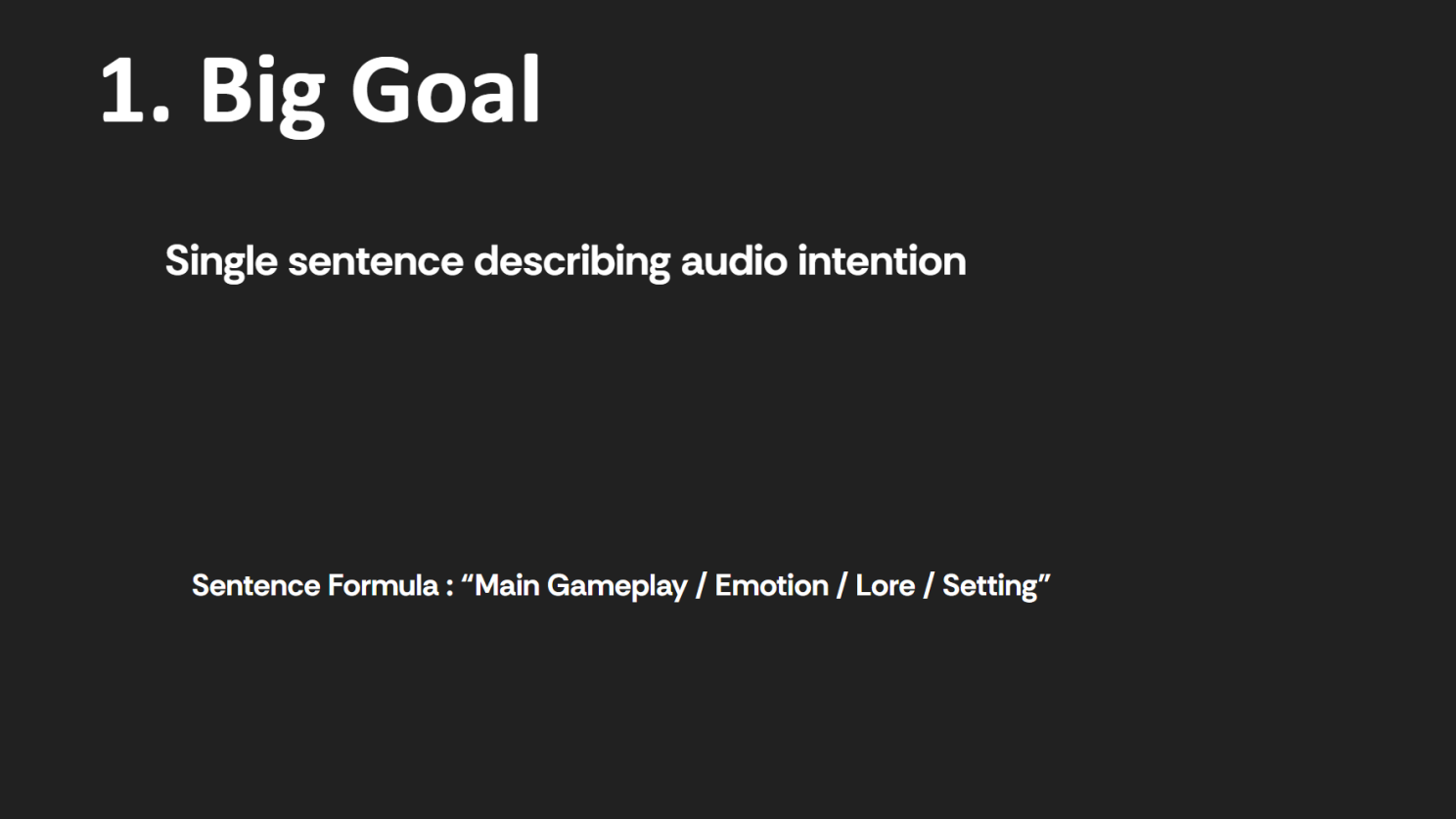
We sit down with the creative team and ask one question : If the sound of this game had to fit in a single sentence, what would it say ? Since one sentence can’t fit everything, we have to choose what matters most.
For a full picture, the sentence should cover four elements:
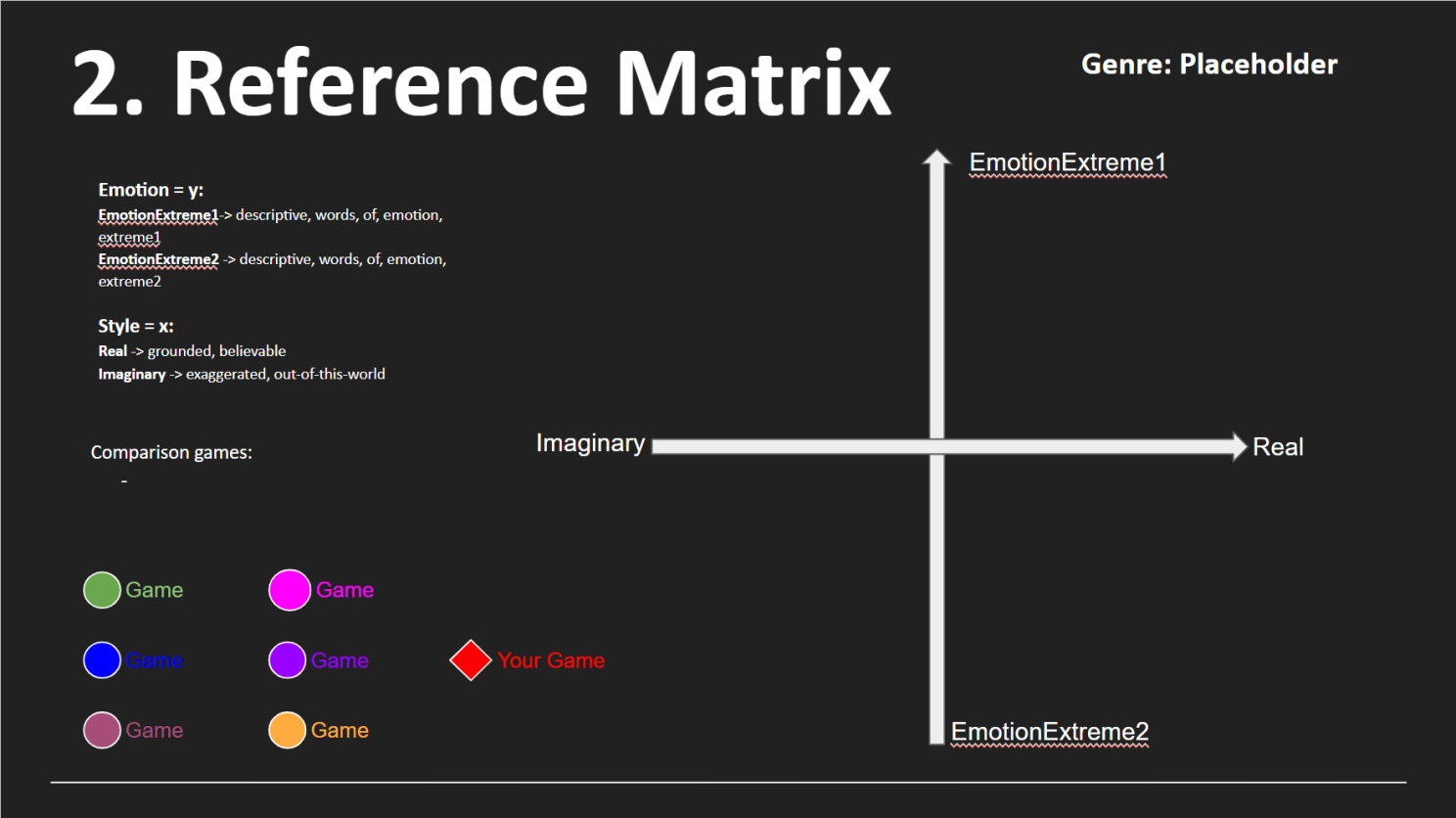
When doing sound design for a game, there is no need to reinvent the wheel. Most games belong to a genre, and the games in that genre shape what our players expect to hear. So in the preproduction phase, we look up the competitors. The games our team loves are a great place to start, since they are probably why this game exists in the first place. Surprisingly, this step is rarely taken. I can’t count how many directors and creatives I’ve seen start a project without knowing how games like theirs usually sound like. Even when you are in a rush, and even for a very small indie game, take at least a day to do this consciously !
(Bonus effect. This forces your team to build a set of common references, to inspire your title or to distance it from similar ones ! )
Once we have 5 to 8 references, we map them on a graph.
The x-axis is Imaginary ↔ Real. It’s the style of the sound design, grounded in realism or more abstract, like cartoony or stylized. This is our fixed axis. We came to it through a lot of experimentation, and it applies to every game, no matter the genre.
The y-axis is the main emotion. It changes with every game and comes straight from our single sentence. We define its two extremes, like Brutal ↔ Friendly for a fighting game. Think of it as the emotional differentiator of the genre, the feeling that really sets the games apart.
Next, we place our references according to how they sound. Instead of describing the sound with words, we draw it. We start with the extremes, and we place the games in relation to each other. Only how they sit relative to each other matters, not their exact positions.
And now we take our own game and place it where we want it to live, in comparison to those games. Suddenly, we can already start to imagine how it will sound !
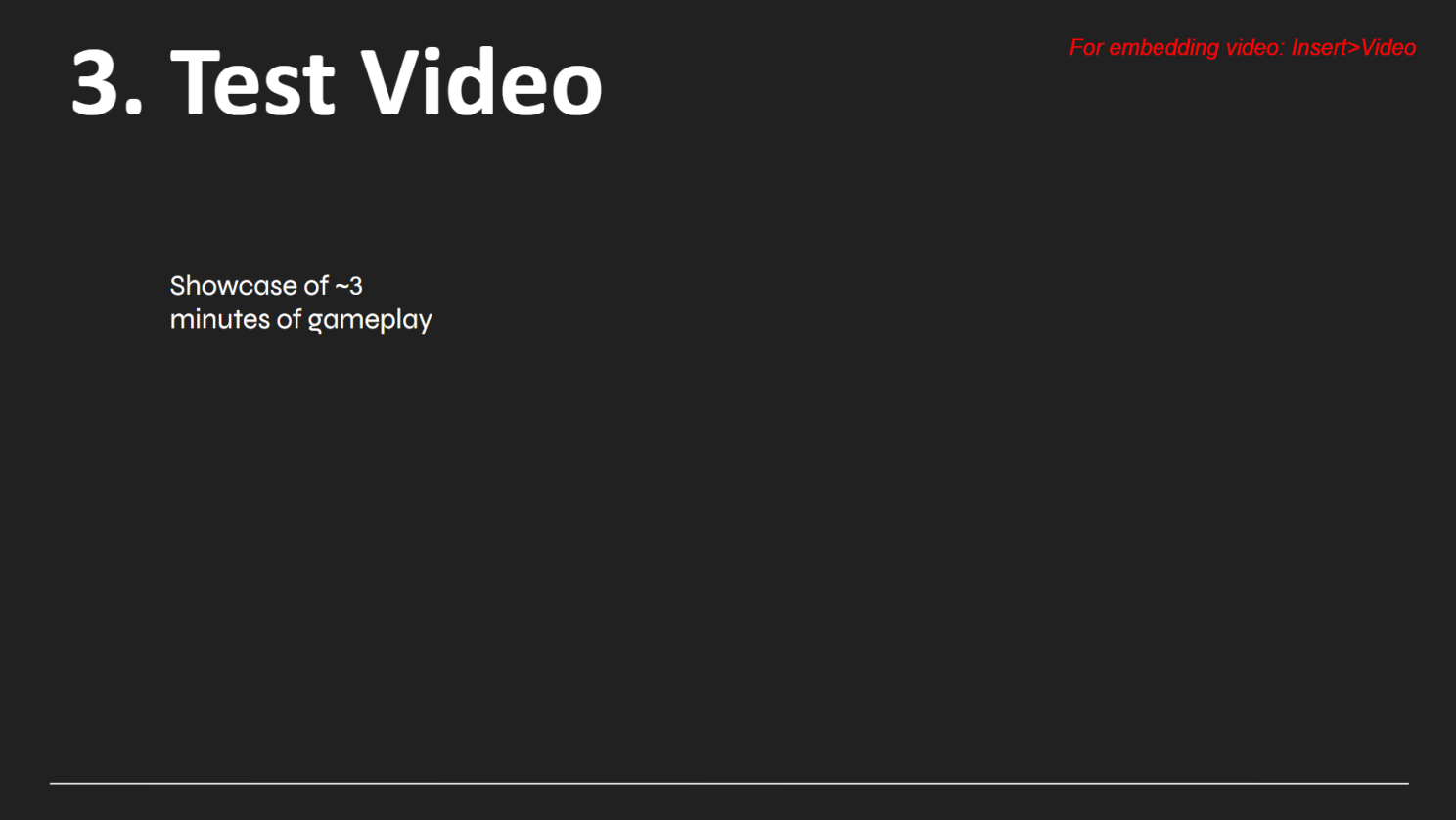
Once production has started and a meaningful portion of the game already has validated sound, we record a few minutes of it in the game. That video becomes our example of the sound direction, and it lives here, in the third slide.
This is less about figuring out where the direction is, and more about having a go-to place where people can hear it. It’s especially useful for new team members, like freshly onboarded sound designers, who need to understand the sound direction quick
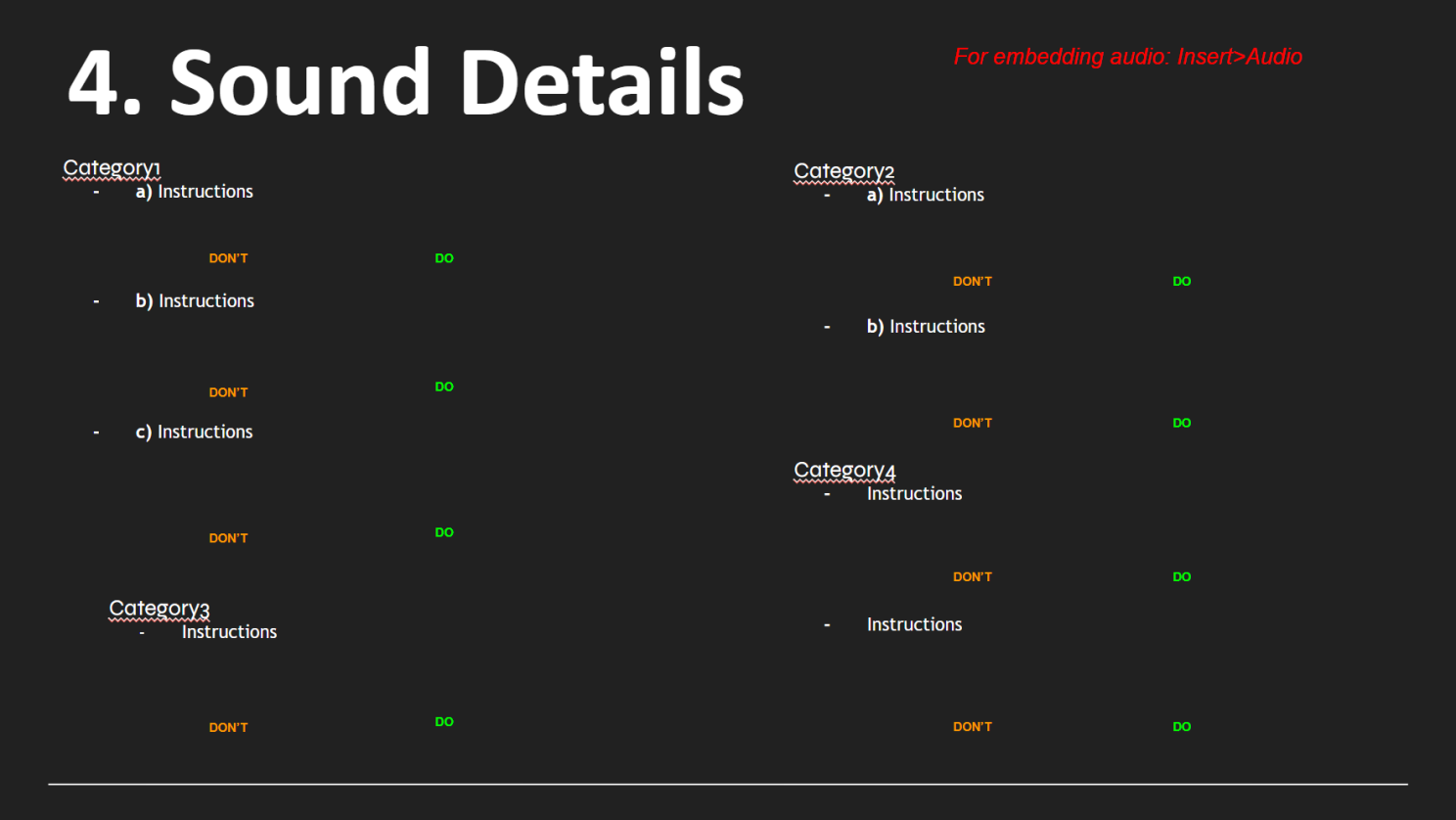
On top of the written descriptions, we embed sounds. DO examples show what we are going for. DON’T examples are sounds we iterated on because they didn’t quite cut it, and we write down why.
A (good) conversation starter
This framework won’t make sound less subjective, and it was never meant to. Nobody will ever hear “epic” the same way, but that’s the reason we love sound. There is so much depth to it.
What it does is give everyone something to point at. A word can mean ten different things, but a reference game cannot. When someone says “like that game, but less cartoony”, that makes it already much clearer in what direction we should go. That is the real value of this framework, and it works from preproduction all the way to the last category of sound details. This document has to stay alive. As the game changes, so do the slides, and the references with them.



© 2026 Demute®. All rights reserved.
All game titles, logos and trademarks are the property of their respective owners.